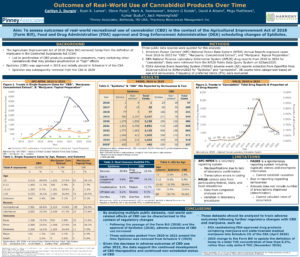
The Agriculture Improvement Act of 2018 (Farm Bill) removed hemp from the definition of marijuana in the Controlled Substances Act (CSA). This led to proliferation of CBD products available to consumers, many containing other cannabinoids that may produce psychoactive or “high” effects. Epidiolex (CBD) was approved in 2018 and initially placed in Schedule V of the CSA. Epidiolex was subsequently removed from the CSA in 2020.
By analyzing multiple public datasets, real-world use related effects of CBD can be characterized in the context of regulatory changes. Following the passage of the Farm Bill (2018) and the approval of Epidiolex (2018), adverse outcomes of CBD use increased. These outcomes peaked from 2020 to 2022 around the time Epidiolex was removed from Schedule V (2020).
Given the decrease in adverse outcomes of CBD use after 2022, the data support the continued development of CBD therapeutics and continued non-scheduled status of CBD.
These datasets should be analyzed to track adverse outcomes following further regulatory changes with CBD and marijuana, such as: DEA rescheduling FDA-approved drug products containing marijuana and state-licensed medical marijuana into Schedule III of the CSA (April 2026) and the 2025 change to the Farm Bill to update the definition of hemp to a total THC concentration of less than 0.3%, rather than only delta-9 THC (November 2026).
This study was funded by Harmony Biosciences Management.
Authors: Caitlyn J. Durgin, Ryan K. Lanier, Steve Pype, Mark Sembower, Kristen G. Bzdek, David A. Albers, Maju Matthews, Kumar Budur, Jack Henningfield
Presented at The College on Problems of Drug Dependence 88th Annual Scientific Meeting, June 2026.